Bases
Bases is a core plugin of Obsidian. A base is a .base file, or a ```base code block, in YAML. It selects notes with filters and shows them in views. The export renders a view as it looks when the PDF is made. The notes here are the project notes shown on the Dataview page.
Markdown
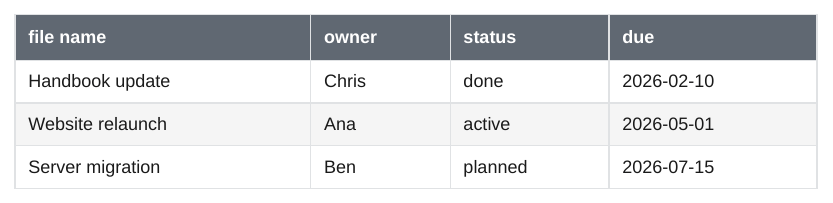
Views
![[Books.base]]and```baseblocks show the first view.![[Books.base#Reading list]]shows the view with that name.tableandcardsviews become a table,listviews a bullet list. Other view types (kanban,map, views of community plugins) become a table, and the export prints a warning.- Columns come from the view's
order(only the file name when there is none), with thedisplayNamefrompropertiesas header. - The file name links to the note when the note is part of the export. Otherwise it is plain text, see links to pages outside the PDF.
sort(several properties,ASCorDESC, empty values last),limit,groupBy(a label line and a table per group),groupOrderand the view'ssummaries(a last row such asSum: 25.5) work.- The global
filtersand the view'sfiltersboth apply.and,orandnotcan be nested.thisis the note that shows the base.
Expressions
| Area | Supported |
|---|---|
| Literals | numbers, "text" and 'text', true, false, null, lists [1, 2], objects, regular expressions /a.c/gi |
| Operators | + - * / %, == != > < >= <=, && \|\| !, a ? b : c, parentheses, x.y, x["y"], list[0] |
| Properties | price, note.price, note["my price"], formula.name, file.*, this.*. A name with a -, such as due-date, is a property when the note has one, otherwise a subtraction. |
| File fields | name, basename, path, folder, ext, size, ctime, mtime, properties, tags, links, embeds, backlinks |
| File functions | hasTag() (nested tags count), inFolder(), hasLink(), hasProperty(), asLink() |
| Global functions | if(), date(), duration(), now(), today(), number(), list(), link(), file(), min(), max(), escapeHTML(), image() |
| Any value | isTruthy(), isType(), isEmpty(), toString() |
| Text | length, contains(), containsAll(), containsAny(), startsWith(), endsWith(), lower(), title(), trim(), replace() (text or regular expression, $1), repeat(), reverse(), slice(), split() |
| Numbers | abs(), ceil(), floor(), round(), toFixed() |
| Lists | length, contains(), containsAll(), containsAny(), filter(), map(), reduce() (with value, index, acc), flat(), join(), reverse(), slice(), sort(), unique(), mean(), sum(), min(), max() |
| Dates | year, month, day, hour, minute, second, millisecond, date(), format() (Moment.js tokens), time(), relative(), date + "1M", date - "2h", date - date (milliseconds) |
| Links | asFile(), linksTo(), comparing links with files and this |
| Objects | keys(), values() |
| Regular expressions | matches() |
| Summaries | Average, Min, Max, Sum, Range, Median, Stddev, Earliest, Latest, Checked, Unchecked, Empty, Filled, Unique, and custom summaries with values |
Anything else, such as html(), icon(), random() or a function that does not exist, is not dropped silently: the export prints a warning that names the base and the expression. A filter that cannot be evaluated is ignored, so the view shows more notes rather than fewer. A column that cannot be evaluated stays empty.
Property types come from the YAML: a date written as 2024-05-01 is a date. The types set in Obsidian (.obsidian/types.json) are not read. Dates are shown as YYYY-MM-DD, checkboxes as ☑ and ☐.